That Spirits Will Be Born Again Into Another Form
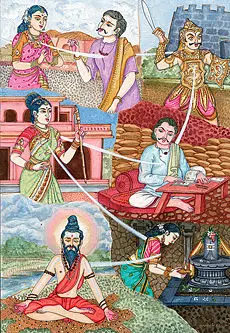
Reincarnation (from Latin meaning "to be made flesh over again") in organized religion and philosophy refers to the conventionalities that a office of a living beingness survives death to be reborn in a new body. This reincarnated self carries with it some essence or identity of the past life into the next life, although it is ordinarily not aware of it. Reincarnation is a central tenet of Hinduism, Buddhism, Jainism, and many theosophical and New Historic period groups.
The monotheistic religions of Judaism, Christianity, and Islam generally practice non accept reincarnation. They teach that each human being is given just one earthly life. However, a Hassidic Jewish doctrine chosen gilgul resembles reincarnation. The Christian thinker Geddes MacGregor adopted reincarnation in order to practise justice to the honey of God, who would requite a second chance for the deceased wicked to be saved. Amongst contemporary spiritualists, opinions on reincarnation are divided, with some accepting information technology as existent and others regarding information technology every bit a harmful belief leading to cases of spirit possession.
The strongest evidence for reincarnation comes from those who allegedly remember details of their by lives. Some hypnotherapists have utilized techniques to call forth early babyhood memories in lodge to plumb memories of past lives, and find recalling such memories helpful in therapy. Researchers such as Ian Stevenson have explored the consequence of reincarnation in a scientific way and published suggestive bear witness. Skeptics remain disquisitional of his piece of work and reincarnation in general.
Contents
- 1 Cursory History
- 2 Eastern Religions
- 2.1 Hinduism
- 2.ii Jainism
- 2.3 Sikhism
- 2.four Buddhism
- two.5 Daoism
- three Western Religions
- 3.one Judaism
- 3.two Christianity
- 3.three Islam
- iv Modern and Contemporary Perspectives
- 4.1 Modern thinkers
- 4.two Anthroposophy
- 4.3 Theosophy
- 4.4 Scientology
- 4.5 Edgar Cayce
- 4.6 Henry Ford
- 4.seven The New Historic period movement
- 5 Scientific Research
- vi Positive Features of Reincarnation
- seven Arguments Confronting Reincarnation
- 7.i Materialist arguments
- seven.2 Spiritualist arguments
- vii.3 Christian arguments
- 7.4 Jewish arguments
- viii Reincarnation in Pop Culture
- 9 Notes
- ten References
- 11 External links
- 12 Credits
For those who reject reincarnation on theological grounds, an alternative way of explaining alleged memories of past lives is to attribute them to the influence of spirits. Sensitive earthly people can receive detailed cognition virtually those spirits' earthly lives and, if they believe in reincarnation, construe it equally memories of their own past lives. Such relationships, according to Christian theologian John Hick, may provide the spirits with opportunities for spiritual growth beyond the grave. The process, though understood within the Christian framework bodily resurrection, provides a second take chances for these spirits to grow and surmount challenges that the failed to master during their earthly lives. It thus provides the same benefit equally reincarnation, although it is a purely spiritual process.
Brief History
In Bharat the concept of reincarnation is first recorded in the Upanishads (c. 800 B.C.East.),[one] which are philosophical and religious texts composed in Sanskrit.
The idea was also entertained past some Ancient Greek philosophers. Among the ancient Greeks, Socrates, Pythagoras, and Plato may exist numbered among those who made reincarnation an integral part of their teachings. At the end of his life, Socrates said, "I am confident that there truly is such a thing every bit living again, and that the living bound from the dead." Pythagoras claimed he could think his past lives, and Plato presented detailed accounts of reincarnation in his major works.[2]
Many Gnostic groups such as the Sethians and followers of Valentinus plainly believed in reincarnation.[3] For them, reincarnation was a negative concept: Gnostics believed that the textile trunk was evil, and that they would exist meliorate off if they could eventually avoid having their 'skillful' souls reincarnated in 'evil' bodies.
In the Hermetica, a Graeco-Egyptian series of writings on cosmology and spirituality attributed to Hermes Trismegistus/Thoth, the doctrine of reincarnation is besides key.
Belief in reincarnation was probably commonplace among the Vikings. The annotator of the Poetic Edda wrote that people formerly used to believe in it, but that it was in his (Christian) fourth dimension considered "one-time wife's folly." Reincarnation besides appears in Norse mythology in the Poetic Edda. The editor of the Poetic Edda says that Helgi Hjörvarðsson and his mistress, the Valkyrie Sváfa, whose love story is told in the Helgakviða Hjörvarðssonar, were reborn as Helgi Hundingsbane and the Valkyrie Sigrún.
Eastern Religions
Eastern beliefs regarding reincarnation are common and tied to presuppositions concerning the existence or not-existence of an indelible 'self.' There are important philosophical differences regarding the nature of the soul (also known as the jiva or atman) amongst the diverse schools of Hinduism and Buddhism. Some schools deny the existence of a 'self', while others merits the beingness of an eternal, personal self, and nonetheless others say in that location is neither cocky or no-self, as both are fake. Each of these beliefs has a straight bearing on the possible nature of reincarnation.
Hinduism
According to Hinduism, the self (atman) is immortal, while the body is field of study to birth and death. The Bhagavad Gita states that: "Worn-out garments are shed by the torso; Worn-out bodies are shed by the dweller within the trunk. New bodies are donned by the dweller, similar garments."[iv]
The idea that the soul (of any living being including animals, humans and plants) reincarnates is intricately linked to karma, another concept first introduced in the Upanishads. Karma (literally: action) is the sum of one's actions, and the force that determines one's adjacent reincarnation. The wheel of expiry and rebirth, governed by karma, is referred to as samsara.
- According to his deeds (karman) the embodied 1 successively
- Assumes forms in various weather.
- Coarse and fine, many in number,
- The embodied i chooses forms according to his own qualities.
- (Each) subsequent cause of his union with them is seen to be
- Because of the quality of his acts and of himself.[5]
Hinduism teaches that the soul goes on repeatedly being born and dying. One is reborn on account of desire: a person desires to be born because he or she wants to bask worldly pleasures, which can be enjoyed only through a body. Hinduism does not teach that all worldly pleasures are sinful, but it teaches that they can never bring deep, lasting happiness or peace (ānanda). According to the Hindu sage Adi Shankaracharya, the earth every bit we ordinarily understand it is like a dream: fleeting and illusory. To be trapped in samsara is a result of ignorance of the true nature of being.
After many births, every person eventually becomes dissatisfied with the limited happiness that worldly pleasures can bring. At this point, a person begins to seek higher forms of happiness, which tin be attained only through spiritual experience. When, later much spiritual do (sādhanā), a person finally realizes his or her own divine nature, i.e., realizes that the true "self" is the immortal soul rather than the body or the ego, all desires for the pleasures of the world volition vanish since they will seem insipid compared to spiritual ānanda. When all want has vanished, the person will non exist reborn anymore.[6]
When the cycle of rebirth thus comes to an end, a person is said to have attained moksha, or conservancy.[7] While all schools of thought agree that moksha implies the cessation of worldly desires and freedom from the bicycle of birth and decease, the exact definition of salvation depends on individual beliefs. For example, followers of the Advaita Vedanta school (often associated with jnana yoga) believe that they will spend eternity absorbed in the perfect peace and happiness that comes with the realization that all existence is One (Brahman), and that the immortal soul is part of that existence. The followers of full or fractional Dvaita schools ("dualistic" schools, such as bhakti yoga), on the other hand, perform their worship with the goal of spending eternity in a loka, (spiritual globe or heaven), in the blest company of the Supreme Beingness (i.due east., Krishna or Vishnu for the Vaishnavas, Shiva for the Shaivites).[8]
Jainism
Jainism, like Hinduism, emphasizes the deposit of karma from past lives equally determinative of i'south current destiny. Inherited karma and the karma caused in i'south own life determine the site of reincarnation. Jainism teaches rigorous asceticism to liberate oneself from the fetters of karma; and in particular by avoiding violence to all living beings. The Jain's ultimate goal is to realize perfection and the land of paramatman, free from all karmic fetters and beyond the accomplish of rebirth.
Sikhism
In Sikhism reincarnation is a key tenet. The Sikhs believe that the Soul has to transmigrate from one torso to another as part of an evolution process of the Soul. This evolution of the Soul volition somewhen results in a matrimony with God upon the proper purification of the spirit. If ane does not perform righteous deeds, ones soul will keep to cycle in reincarnation forever. A being who has performed good deeds and deportment in their lives is transmigrated to a better and higher life grade in the adjacent life until the soul of the being becomes Godlike.[ix]
Buddhism
The Buddha taught a concept of rebirth that was distinct from reincarnation. The Buddhist concept of rebirth, although often referred to as reincarnation, differs significantly from the Hindu-based traditions and New Historic period movements in that there is no "self" (or eternal soul) to reincarnate. This concept was consistent with the mutual notion of a sequence of related lives stretching over a very long time, but was constrained past two core Buddhist concepts: anattā, that there is no irreducible ātman or "cocky" tying these lives together; and anicca, that all compounded things are discipline to dissolution, including all the components of the human person and personality. At the death of ane personality, a new one comes into being, much equally the flame of a dying candle can serve to light the flame of another.[ten]
Since according to Buddhism there is no permanent and unchanging self (identify) in that location tin can exist no transmigration in the strict sense. However, the Buddha himself referred to his past-lives. Buddhism teaches that what is reborn is non the person, but that one moment gives ascent to some other, and that that momentum continues, even after death. Information technology is a more subtle concept than the usual notion of reincarnation, reflecting the Buddhist concept of personality existing (even within ane's lifetime) without a "soul."
Buddhism nevertheless affirms samsara, the continual process of expiry and rebirth. But there is nothing skillful near it. The offset of the 4 Noble Truths is that everything from nascence to death is suffering. Reincarnation is the machinery by which suffering continues life after life. The factors such every bit craving and egoism that condition a life and propel it into the adjacent life are fetters that must exist overcome. The Buddhist'south goal is to reach Nirvana and cease the cycle of reincarnation forever.
Reincarnation may sometimes provide a ladder to Nirvana for aspirants who devote themselves to the Buddha's teaching but who are not avant-garde enough to attain Nirvana in one lifetime. Tibetan Buddhists thus believe that a new-born child may be the rebirth of some important departed lama. However, for the peachy majority of people reincarnation brings an evil destiny, due to accumulation of bad karma. Many end up spending their next life in one of the Buddhist hells earlier rising to enjoy some other being, and fifty-fifty and then information technology is said to be very rare for a person to be reborn in the immediate next life as a homo.[eleven]
Sooner, exercise I declare, would a i-eyed turtle, if he were to pop up to the surface of the sea only in one case at the end of every hundred years, take a chance to push his neck though a yoke with one pigsty than would a fool, who has once gone to the Downfall, exist reborn as a human. (Samyutta Nikaya v.455)
Daoism
Daoism does non take a articulate didactics on reincarnation. Notwithstanding Daoist documents from the Han Dynasty claim that Lao Zi appeared on earth in different persons in different times beginning from the time of Three Sovereigns and V Emperors. An of import scripture of Daoism, the Chuang Tzu (fourth century B.C.Due east.), states:
Nascence is not a commencement; expiry is non an end. There is beingness without limitation; there is continuity without a starting-point. Beingness without limitation is Space. Continuity without a starting-point is Time. There is birth, there is decease, there is issuing forth, there is inbound in. That through which one passes in and out without seeing its course, that is the Portal of God.[12]
This passage is usually interpreted to signify the state of immortality achieved by the sage, transcending life and death, rather than reincarnation as the condition of the unenlightened.
Western Religions
Judaism
The thought that the soul is eternal has been a role of Judaism since the second century B.C.Due east. The primeval expression of this idea was the doctrine of resurrection of the dead. Josephus, the Roman-Jewish historian, writes about the Pharisees, "they say that all souls are incorruptible, just that the souls of skilful men only are removed into other bodies, — simply that the souls of bad men are subject to eternal punishment."[13] This was not reincarnation over many lifetimes, just only once, into a new incorruptible body.
A concept of reincarnation, called gilgul, became pop in Medieval folk Judaism, and is institute in much Yiddish literature among Ashkenazi Jews. Among some Kabbalists, it was posited that some human souls could end up beingness reincarnated into non-human bodies. These ideas were establish in a number of Kabbalistic works from the 1200s, and also amidst Hassidic Jews in the late 1500s. Martin Buber's collection of stories of the Baal Shem Tov'southward life includes several that refer to people reincarnating in successive lives.
Among well known (generally non-Kabbalist or anti-Kabbalist) Rabbis who rejected the idea of reincarnation are the Saadia Gaon, Hasdai Crescas, Yedayah Bedershi, Joseph Albo, Abraham ibn Daud, the Rosh and Leon de Modena. The Saadia Gaon in his Emunoth ve-Deoth concludes Section vi with a refutation of the doctrine of metempsychosis (reincarnation), stating that Jews who agree to reincarnation take adopted non-Jewish beliefs.
While most Jews today practise not believe in reincarnation, the belief is common in Orthodox Judaism. Near Orthodox siddurim (prayerbooks) have a prayer request for forgiveness for one'south sins that one may have committed in this gilgul or a previous ane.
Christianity
The overwhelming majority of mainstream Christian denominations decline the notion of reincarnation and consider the theory to claiming basic tenets of their beliefs. A number of Evangelical and Fundamentalist Christian groups accept denounced any belief in reincarnation as heretical, and explained whatever phenomena suggestive of it as deceptions of the devil. Many churches do not directly address the issue, but indirectly through teachings well-nigh death and resurrection.
The Bible never mentions the word reincarnation, although information technology contains passages in the New Testament that could be interpreted to allude to reincarnation. In Matthew 11:10-14 and 17:10-thirteen, Jesus says that John the Baptist is the prophet Elijah who had lived centuries earlier, and he does not appear to be speaking metaphorically. However, it should be noted that Elijah never really died, but was raptured in a chariot of burn down. Furthermore, the prophetic texts stated that God would send Elijah back to Earth, as a straw of Jesus Christ. Conversely, there are several passages in the New Testament (such as Hebrews 9:27 and Luke 16:20-31) that Orthodox Christians interpret every bit openly rejecting reincarnation or the possibility of any return or contact with this globe for the souls in heaven or hell.
New Historic period Christians debate that reincarnation was taught by the early Christian church, but that due to bias and mistranslations, this instruction was lost or obscured.[xiv] Most of the philosophies associated with the theory of reincarnation focus on "working" or "learning" through various lifetimes to achieve some sort of higher understanding or land of "goodness" earlier salvation is granted or acquired.
Several Christian denominations which back up reincarnation include the Christian Community, the Liberal Catholic Church building, Unity Church building, the Christian Spiritualist Movement, the Rosicrucian Fellowship and Lectorium Rosicrucianum. The Medieval sect known variously as the Cathars or Albigensians which flourished in the Languedoc likewise believed in reincarnation, seeing each soul equally a fallen angel built-in over again and again into the globe of affair created past Lucibel (Match). Just through a Gnostic 'Rebirth' in the Holy Spirit through Christ could the soul escape this process of successive existences and return to God.
Some gimmicky Christian thinkers take attempted to entwine Christianity and reincarnation. Geddes MacGregor, an Anglican priest and theologian, argued that when Christianity without a doctrine of reincarnation teaches that we are given only i earthly life which determines, once for all, whether nosotros go to heaven or hell, it is contradictory to a God of dear.[xv]
Islam
Mainstream Islam rejects the concept of reincarnation.[16] However, a number of Sufi groups believe in reincarnation, as reflected in the following verse form of Jalalu'ddin Rumi:
- I died as mineral and became a plant,
- I died every bit institute and rose to animal,
- I died every bit beast and I was man.
- Why should I fear?
- When was I less by dying? [17]
Modern Sufis who comprehend the idea of reincarnation include Chiliad.R. Bawa Muhaiyadeen and Hazrat Inayat Khan.[18] [19]
Reincarnation has also been used to reconcile the [[Qur'an]['south credible identification of Miriam, the mother of Isa, as the sister of Aaron and daughter of Amran, all of whom lived well before the starting time century C.E.
Another verse of the Qur'an that may support the theory of reincarnation is:
- M [God] makest the nighttime to pass into the 24-hour interval and G makest the day to pass into the night, and Thousand bringest forth the living from the dead and Thou bringest forth the dead from the living, and Thousand givest sustenance to whom Thou pleasest without measure out (Qur'an 3:27).
Yet, other verses of the Quran that seem to discount repeated lives, save the ane rebirth that all people will feel at the concluding resurrection:
- "From the (globe) did Nosotros Create yous, and into it Shall We return you, And from it shall We Bring you out in one case again" (20:55).
- "And Allah has produced you from the earth, Growing (gradually), And in the End He volition return you Into the (world), And raise you lot forth (Once again at the Resurrection)" (71:17-eighteen).
- "Nor will they in that location Gustation Decease, except the starting time Expiry; and He will preserve Them from the Penalization Of the Blazing Fire" (44:56).
- "Is information technology (the example) that We shall not die, except our first expiry, And that nosotros Shall non be punished?' Verily this is The supreme achievement! For the similar of this Allow all strive, Who wish to strive" (37:58-61).
Modern and Contemporary Perspectives
Modern thinkers
During the Renaissance, a new flowering of public interest in reincarnation occurred. One of the prominent figures in the revival was the Italian philosopher and poet Giordano Bruno, who was ultimately burned at the stake past the Inquisition.
During the classical period of German literature, metempsychosis ("transmigration of the soul") attracted much attention: Goethe played with the idea, and it was taken upward more seriously past Lessing and past Herder. It was mentioned with respect past Hume and by Schopenhauer.
Irish gaelic poet and Nobel Laureate William Butler Yeats proposed a novel theory of reincarnation in his occult treatise A Vision. [20] According to his view, reincarnation does not occur within a framework of linear time. Rather, all of a person'southward by and time to come lives are happening at once, in an eternal now moment, and the decisions made in whatsoever of these lifetimes influence all of the other lives (and are influenced by them).
Anthroposophy
Reincarnation plays an important role in the ideas of Anthroposophy, a spiritual move founded by Rudolf Steiner. Steiner described the human soul every bit gaining new experiences in every epoch and in a multifariousness of races or nations. The unique personality, with its weaknesses and abilities, is not just a reflection of the body'southward genetic heritage. Although Steiner described the incarnating soul as searching for and even preparing a familial lineage supportive of its future life, a person'southward grapheme is too determined past his or her past lives.
Anthroposophy describes the present equally being formed by a tension between the past and the future. Both influence our nowadays destiny; at that place are events that occur due to our past, but there are besides events that occur to prepare us rightly for the future. Between these two, there is space for human free will; nosotros create our destiny, non only alive it out, merely as nosotros build a house in which we then choose to live.
Anthroposophy has adult various spiritual exercises that are intended to develop the capacity to discern past lives and the deeper nature of the human being. In addition, Steiner investigated the karmic relationships of many historical individuals, from Karl Marx to Julian the Backslider.
Theosophy
Modern theosophy, which draws its inspiration from India, has taken reincarnation as a fundamental tenet; it is, according to a recent theosophical writer, "the master-key to modern problems," including heredity.[21]
Scientology
Past reincarnation, usually termed "past lives", is a key part of the principles and practices of the Church building of Scientology. Scientologists believe that the human individual is actually an immortal thetan, or spiritual entity, that has fallen into a degraded state as a result of past-life experiences. Scientology auditing is intended to free the person of these past-life traumas and recover past-life memory, leading to a college state of spiritual awareness. This idea is echoed in their highest fraternal religious order, the Body of water Organization, whose motto is "Revenimus" or "We Come Dorsum", and whose members sign a "billion-year contract" equally a sign of commitment to that platonic. L. Ron Hubbard, the founder of Scientology, does not apply the word "reincarnation" to depict its beliefs, and the official website of Scientology notes that:
The common definition of reincarnation has been altered from its original meaning. The discussion has come to mean 'to exist born again in different life forms' whereas its bodily definition is 'to be built-in again into the mankind of another body.' Scientology ascribes to this latter, original definition of reincarnation.[22]
The first writings in Scientology regarding by lives appointment from around 1951 and slightly earlier. In 1960, Hubbard published a book on past lives entitled Accept Y'all Lived Before This Life? In 1968 he wrote Mission Into Time, a report on a v-calendar week sailing expedition to Sardinia, Sicily and Carthage to see if specific testify could be found to substantiate his recall of incidents in his own past, centuries ago.
Edgar Cayce
American [[mysticism}mystic]] Edgar Cayce promoted the theory of both reincarnation and karma, wherein they human action every bit instruments of a loving God as well equally natural laws—the purpose being to teach us certain spiritual lessons. Animals are said to have undifferentiated, "group" souls rather than individuality and consciousness. Once the soul evolves through a succession of beast incarnations and achieves human being status, it is non then reborn in animate being class. Cayce's view arguably incorporates theosophical teachings on spiritual evolution.
Henry Ford
American industrialist Henry Ford was convinced that he had lived earlier, near recently as a soldier killed at the Battle of Gettysburg. A quote from the San Francisco Examiner from August 26, 1928 described Ford'south beliefs:
I adopted the theory of Reincarnation when I was twenty-six. Organized religion offered cipher to the betoken. Even piece of work could not give me consummate satisfaction. Piece of work is futile if nosotros cannot utilise the experience we collect in one life in the next. When I discovered Reincarnation it was as if I had found a universal plan I realised that there was a chance to work out my ideas. Time was no longer express. I was no longer a slave to the easily of the clock. Genius is experience. Some seem to think that it is a gift or talent, but it is the fruit of long experience in many lives. Some are older souls than others, so they know more than. The discovery of Reincarnation put my mind at ease. If you preserve a record of this conversation, write information technology so that it puts men's minds at ease. I would similar to communicate to others the calmness that the long view of life gives to us.
The New Age movement
There are people who say they recollect their past lives and utilize that knowledge to help them with their current lives; the conventionalities in this kind of occurrence is primal to the New Historic period motion.[23] Some of the people who remember say they simply recall without whatsoever try on their office. They just "see" previous times and see themselves interacting with others, occasionally even dissimilar creatures too people themselves.
Scientific Research
The nearly detailed collections of personal reports in favor of reincarnation have been published by Professor Ian Stevenson, from the Academy of Virginia, in books such every bit Xx Cases Suggestive of Reincarnation. Stevenson spent over xl years devoted to the study of children who have manifestly spoken almost a by life. In each case, he methodically documented the child'south statements. Then he identified the deceased with whom the child allegedly identified, and verified the facts of the deceased person's life that matched the child's memory. He also matched birthmarks and nascence defects to wounds and scars on the deceased, verified by medical records such as dissection photographs.[24]
In a adequately typical example, a boy in Beirut spoke of being a 25-yr-old mechanic, thrown to his death from a speeding car on a beach road. According to multiple witnesses, the boy provided the proper name of the driver, the exact location of the crash, the names of the mechanic's sisters and parents and cousins, and the people he went hunting with—all of which turned out to match the life of a homo who had died several years before the male child was born, and who had no apparent connection to the male child'southward family.[25]
Stevenson believed that his strict methods ruled out all possible "normal" explanations for the child's memories. However, information technology should be noted that a pregnant majority of Professor Stevenson'southward reported cases of reincarnation originate in Eastern societies, where dominant religions often permit the concept of reincarnation. Following this blazon of criticism, Stevenson published a book entitled European Cases of the Reincarnation Type (2003).[26]
Nevertheless, an unexpected result that casts doubt on reincarnation as an explanation for Stevenson's findings was that in the great majority of cases, the children'south recollections involved people who had met some sort of trigger-happy or untimely expiry.[27] This may betoken to spiritual influence or possession as a amend explanation for the children'southward alleged memories. At that place is no reason why people who met violent deaths should be reincarnated more ofttimes than others, but they are more than likely to be earthbound and hence to seek out a vulnerable person to influence or possess.
There are many people who have investigated reincarnation and come to the conclusion that it is a legitimate miracle, such as Peter Ramster, Brian Weiss, Walter Semkiw, but amongst them only Professor Stevenson has published in peer-reviewed journals.[28]
Positive Features of Reincarnation
The doctrine of reincarnation has many positive features that recommend information technology:
- It offers i of the classic explanations for why some people suffer misfortune while others enjoy a lucky life: the misfortune can be explained as the consequence of my own misdeeds in a previous life.
- It maintains the justice of the cosmos by insisting that each person is responsible for their own future.
- It provides a reason to endure suffering and pain, for the sake of expiating sins of past lives. This is a good doctrine for the religious life.
- It dampens pride. Whatsoever our proficient qualities, in past lives we no doubtfulness committed many sins. Although in this life nosotros might enjoy privilege and high status, in by lives we were no doubt living in poverty and wretchedness.
- In the modern New Age clothes, reincarnation is good news, since it gives everyone a second chance. This helps explain its popularity.
- It creates human solidarity, since anyone nosotros meet could be a brother, a granddaughter, a mother or a son. In a previous life I might accept been my neighbor's father; therefore that neighbor is my son. My worst enemy may be my son or grandson. Therefore, to wrong whatever homo may be harming my own kin.
- It creates solidarity with all creatures, because they besides may be reincarnated humans, and I might have been one of them in a by life. Reincarnation links all life together in a seamless spider web; that steak you just ate might have come up from a cow that was i of your offspring from a previous life when you were a moo-cow.
- Reincarnation is compatible with Eastern cultures which are attuned to the cyclic rhythms of nature. The rebirth of souls into new bodies is equally natural equally the new growth of plants every spring.
- For Christians like Geddes MacGregor, giving people a second chance is confirms the dearest of God. It is therefore superior to traditional pedagogy that sinners are judged to eternal punishment in hell.
Arguments Confronting Reincarnation
Materialist arguments
The most obvious objection to reincarnation is that at that place is no evidence of a physical process by which a personality could survive death and travel to another torso.[29] This same objection would use to all beliefs in survival after death.
Some skeptics explicate that claims of testify for reincarnation originate from selective thinking and the psychological phenomena of false memories that ofttimes result from one's own belief system and basic fears, and thus cannot be counted as empirical evidence.
Spiritualist arguments
Spiritualists believe in the soul'south survival later expiry, after which they accept on a new being in the afterlife. Many are mediums or channels for spirits on the other side. They are divided in their views on reincarnation. Those with theosophical leanings or who follow in the footsteps of Edgar Cayce are proponents of reincarnation. Critics reply that credible reincarnation is really possession or influence past other spirits. Edith Fiore, writer of The Unquiet Dead,[30] has worked with children and adults who have spirits attached to them or possessing them; they tin create apparent memories and feelings in the person possessed that can be interpreted by believers in reincarnation as recollections of past lives. The possessing spirit tries to live through its host, even so the result is to damage the host person's identity. Cultures where belief in reincarnation is widespread can create an unhealthy spiritual burden on the living, as departed spirits believe they should attach themselves to newborns.
Christian arguments
Among the Christian arguments that tin be construed against reincarnation are:
- Scripture promises eternal life to those who believe (John 3:16). If a believer who had assurance of eternal life were reincarnated into a body of a non-believer, his eternal life would be falsified.
- Jesus died one time and for all, to save sinners. Therefore conservancy in Jesus Christ is good for eternity. Existence once and for all, it is a ameliorate hope than reincarnation.
- For believers scripture offers the promise of the resurrection—an eternal future in a glorified, spiritual body (one Corinthians 15:44). Reincarnation would vitiate that promise. If a believer who had assurance of the resurrection were reincarnated into a body of a non-believer who died in sin, so his quondam balls would be falsified. If a believer were reincarnated afterward the resurrection, it would mean that the resurrection was not eternal.
- God created Adam from the dust and breathed into him of his spirit (Genesis 2:7). Likewise, every person is a unique creation of God. A person who arrives on earth as the result of previous lives is not God'due south unique cosmos. Thus the doctrine of reincarnation makes it difficult for people to relate to God equally their creator.
- God created each person to take a relationship of dearest with him, uniquely and eternally. God exists eternally. To be fully loved by God requires awareness of one'due south identity, one's deeds and one's qualities, which likewise exist eternally. Reincarnation allows for no such enduring awareness on the part of the individual, fifty-fifty though God would know him well through many lifetimes. This would create a large gap between fully-enlightened God and ignorant humans. It would thus frustrate the purpose for which we were created.
- God created human beings to dear one another, and instituted the family then we could grow in our love for spouses, siblings, parents and children. Co-ordinate to Emanuel Swedenborg, conjugal beloved continues to exist in afterlife. Reincarnation, although it can create some kind of solidarity of all humans, even so still views each individual as ultimately alone, forming families which will deliquesce, leaving no retentiveness backside. For Christianity, God is love, and his works are about the fulfillment of dearest. In this lite, the doctrine of reincarnation falls short of the ideal of love.
- The Bible teaches the absolute distinction between humans and animals; only the erstwhile are created with God'southward spirit. Furthermore, God creates every beingness uniquely "according to its kind," that the soul of each being may manifest that being's outward course. Hence a homo soul cannot exist reincarnated into a domestic dog, or vice-versa; they are different in kind.
Thus, reincarnation understood every bit a procedure of continual re-embodiment of the soul in a succession of earthly lives is unacceptable to Christianity. One drawback of Christianity, however, due in part to its rejection of reincarnation, is that it besides rejects the conservancy of those who accept gone to hell. It seems to many that this hardly justifies the dear of God. Even the hope of resurrection is but for those who go to heaven, considering the resurrection of the wicked but helps to intensify their curse. You are given merely one earthly life, which, once for all, determines whether you lot go to sky or hell after y'all dice. No second adventure. (The only exceptions are "purgatory" and "limbus patrum," i.e., "limbo of the fathers," equally understood in the Catholic Church; in purgatory those who practice not go to heaven nor to hell due to their impropriety sins tin nonetheless be apple-pie to become to heaven eventually, and in the limbus patrum Hebrew forefathers such as Jacob and Moses stay until the coming of Christ, at which time they are finally immune to participate in Christian salvation.)
Being aware of this drawback of Christianity, theologian John Hick has explored an alternative way of re-embodiment which still rejects reincarnation simply which gives a second chance for salvation or liberation after death. For this purpose, Hick has given a new meaning to the Christian notion of bodily resurrection. Although conventional Christianity denies that resurrection can bring salvation to the wicked once they die, Hick's new conception of resurrection brings forth the spiritual growth of an imperfect and even wicked person later expiry. In his view, the environment of an objective customs of resurrected, re-embodied persons in the other world "generates the moral pressures by which we may abound as persons."[31]
Jewish arguments
Generally, Jews who object to reincarnation would raise many of the above Christian arguments. In add-on, a thoroughgoing doctrine reincarnation would run counter to the Jewish sense of uniqueness as a chosen people, as Jews would sometimes reborn every bit a Gentiles and Gentiles equally Jews. The Jewish doctrine of gilgul, although comparable to reincarnation, is actually not. The living person retains his own personality and individuality even as he represents the transmigrated soul of his forbearer. All accounts of gilgul are almost the transmigration of old Jewish souls into other Jews.
Reincarnation in Popular Culture
Reincarnation seems to take captured the imagination of many in the Westward, and the thought receives regular mention in feature films, popular books, and popular music. Numerous feature films accept made reference to reincarnation, and notable films include:
- Audrey Rose (1977)
- Birth (2004)
- Dead Over again (1991)
- Defending Your Life (1991)
- Fluke (1995)
- Karz (1980)
- Kudrat (1980)
- Kundun (1997)
- Little Buddha (1993)
- Mahal (1949)
- Reincarnation (2005)
- Star Trek Iii: The Search for Spock (1984)
- The Reincarnation of Peter Proud (1975)
- The Iii Lives of Thomasina (1964)
- What Dreams May Come up (1998)
- Om Shanti Om (2007)
Notable popular songs or albums which refer to reincarnation include:
- "The Reincarnation of Benjamin Breeg" by Iron Maiden
- "The Reincarnation Vocal" by Roy Zimmerman
- Eternal Caravan of Reincarnation past Santana
- The Reincarnation of Luna by My Life With The Thrill Kill Kult
- Highwayman by The Highwaymen
- Tommy by The Who
- "Galileo" by The Indigo Girls
Reincarnation is subject of "Thursday's Fictions," a cantankerous media work which has transmigrated beyond the commitment platforms of stage spectacle (1995), book (1999), pic (2006), 3D online immersive story word in 2nd Life (2007), and machinima series (2007).
Notes
- ↑ See Śvetāśvatara Upanishad v.xi and Kauśītāki Upanishad i.two.
- ↑ "Reincarnation: Socrates to Salinger."harekrishna.com. Retrieved September 13, 2008.
- ↑ Much of this is documented in R.E. Slater. Paradise Reconsidered: nine/11 and 7/7, Reincarnation, and the Lost Gospel of Jesus. (Crest Publishing, 2006).
- ↑ Bhagavad-Gita: The Song of God, trans. Swami Prabhavananda and Christopher Isherwood (Signet Classics, 2002), 37. ISBN 0451528441
- ↑ "Śvetāśvatara Upanishad" five.11-12, in Robert Ernest Hume, ed., Thirteen Principal Upanishads. (London: Oxford University, 1921), 407. online [1]googlebooks. Retrieved September 13, 2008.
- ↑ Robin Rinehart. Contemporary Hinduism: Ritual, Culture, and Practice. (ABC-CLIO, 2004), nineteen-21.
- ↑ Karel Werner. A Popular Dictionary of Hinduism. (Curzon Press, 1994), 110.
- ↑ Gospel of Sri Ramakrishna, trans. Swami Nikhilananda (New York: Ramakrishna-Vivekananda Center, 1985. ISBN 0911206019)
- ↑ SikhiWiki, encyclomedia of the Sikhs. online "Reincarnation." Retrieved September 13, 2008.
- ↑ "Transmigration and Rebirth," Milindapañha. accesstoinsight.org.Retrieved September 13, 2008.
- ↑ Kusala Bhishu, "The Five Precepts."urbandharma.org. Retrieved September 14, 2008.
- ↑ "Chuang Tzu," chap. 24. Retrieved June 17, 2008.
- ↑ Flavius Josephus. The War of the Jews. Book II, Chapter 8, Poetry 14.
- ↑ J.J. Dewey,"Reincarnation and the Bible." Retrieved June 17, 2008.
- ↑ Geddes MacGregor. Reincarnation in Christianity: A New Vision of Rebirth in Christian Thought. (Theosophical Pub House, 1978).
- ↑ Questions and Answers from The Noble Koran, "What does Islam call up about reincarnation?"answering-christianity.com. Retrieved September xiii, 2008.
- ↑ Raynold A. Nicholson. The Mystics of Islam. (London: Routledge, 1914), 168.
- ↑ M.R. Bawa Muhaiyadeen. To Dice Before Death: The Sufi Way of Life. (The Fellowship Press, 1997)
- ↑ Hazrat Inayat Khan. The Sufi Message, vol. V. (Motilal Banarsidass, 1995), part 3.
- ↑ William Butler Yeats. A Vision. (New York: Collier Books, 1966).
- ↑ "Theosophy—Modern Presentations: Reincarnation."blavatskytrust.org.great britain. Retrieved September xiv, 2008.
- ↑ "Does Scientology believe in reincarnation or by lives?"scientology.org. Retrieved September 14, 2008.
- ↑ Ken Ring, "Reincarnation and NDE Research."neardeath.com. Retrieved September 14, 2008.
- ↑ Richard Rockley, "Volume Review: Children who Call up Previous Lives past Ian Stevenson." skepticreport.com. Retrieved June xviii, 2008.
- ↑ Tom Shroder, "Ian Stevenson; Sought To Certificate Memories Of Past Lives in Children," Washington Mail, 11 Feb, 2007, sec. C. [2]washingtonpost.com. Retrieved June 18, 2008.
- ↑ Remi J. Cadoret, review of European Cases of the Reincarnation Type, by Ian Stevenson, The American Periodical of Psychiatry 162 (2005): 823-824. [3]. American Periodical of Psychiatry. Retrieved June 18, 2008.
- ↑ Jim Tucker. Life Before Life: A Scientific Investigation of Children's Memories of Previous Lives. (St. Martin'south Press, 2005), 214.
- ↑ University of Virginia, Segmentation of Perceptual Studies, "Books and Articles by Division Staff." Retrieved June eighteen, 2008.
- ↑ Tom Shroder, "Ian Stevenson; Sought To Certificate Memories Of Past Lives in Children," Washington Post, 11 February, 2007, sec. C. [4]. Retrieved June 18, 2008.
- ↑ Edith Fiore. The Unquiet Expressionless: A Psychologist Treats Spirit Possession. (Ballantine Books, 1995).
- ↑ John Hick, "Life later Expiry," in The Westminster Lexicon of Christian Theology, ed. Alan Richardson and John Bowden. (Philadelphia: Westminster Press, 1983), 331-334.
References
ISBN links support NWE through referral fees
Scientific Publications
- Edwards, Paul. Reincarnation: A Critical Examination. Prometheus Books, 2001. ISBN 1573929212
- Fiore, Edith. The Unquiet Expressionless: A Psychologist Treats Spirit Possession. Ballantine Books, 1995. ISBN 0345460871
- Hubbard, L. Ron. Take You Lived Earlier This Life?: A Scientific Survey. A Study of By Lives through Dianetic Engrams. Vantage Printing. 1960.
- Huxley, Thomas Henry. 1895. Evolution and Ethics and Other Essays. reprint ed. Kessinger Publishing, 2004. ISBN 1419118757
- Shroder, Thomas. Old Souls: Compelling Evidence from Children Who Remember By Lives. Simon & Schuster, 2001. ISBN 0684851938
- Stevenson, Ian. Children Who Remember Previous Lives: A Question of Reincarnation, revised ed. Revised ed. McFarland & Visitor, 2000. ISBN 0786409134
- Stevenson, Ian. European Cases of the Reincarnation Blazon. McFarland & Visitor, 2003. ISBN 0786414588
- Stevenson, Ian. Reincarnation and Biology: A Contribution to the Etiology of Birthmarks and Birth Defects. two vols. Westport, CT: Praeger, 1997. ISBN 0275952827
- Stevenson, Ian. Twenty Cases Suggestive of Reincarnation, 2nd ed., revised and enlarged. Academy of Virginia Press, 2001. ISBN 9780813908724
- Tucker, Jim. Life Before Life: A Scientific Investigation of Children's Memories of Previous Lives. St. Martin's Press, 2005. ISBN 0312321376
Other Publications
- Alegretti, Wagner. Retrocognitions: An Investigation into Memories of Past Lives and the Menses Betwixt Lives. International Academy of Consciousness, 2004. ISBN 0970213166
- Archiati, Pietro. Reincarnation in Modern Life: Toward a new Christian Awareness. Temple Lodge Publishing, 1998. ISBN 0904693880
- Bache, Christopher M. Lifecycles: Reincarnation and the Spider web of Life. Paragon House Publishers, 1994. ISBN 1557786453
- Bowman, Carol. Children's Past Lives: How Past Life Memories Affect Your Child. Bantam, 1998. ISBN 055357485X
- Cerminara, Gina. Many Mansions: The Edgar Cayce Story on Reincarnation. Signet, 1971. ISBN 0451033078
- Childs, Gilbert and Sylvia. Your Reincarnating Child: Welcoming a Soul to the World. Rudolf Steiner Press, 2005. ISBN 1855841266
- Hubbard, L. Ron. Mission Into Time. Bridge Pubns, 1973. ISBN 0884040232
- Khan, Hazrat Inayat. The Sufi Message. Vol. V. Motilal Banarsidass, 1995. ISBN 8120806107
- MacGregor, Geddes. Reincarnation in Christianity: A New Vision of Rebirth in Christian Thought. Theosophical Pub House, 1978. ISBN 0835605019
- Muhaiyadeen, K.R. Bawa. To Dice Before Death: The Sufi Way of Life. The Fellowship Press, 1997. ISBN 0914390392
- Prophet, Elizabeth Clare. Reincarnation: The Missing Link in Christianity. Meridian University Printing, 1997. ISBN 0922729271
- Ramster, Peter. In Search of Lives Past. Somerset Films & Pub, 1992. ISBN 0646000217
- Rinehart, Robin. Contemporary Hinduism: Ritual, Civilization, and Practice. ABC-CLIO, 2004. ISBN 1576079058
- Roberts, Jane. Seth Speaks: The Eternal Validity of the Soul. Bantam Books, 1978. ISBN 0553120778
- Slater, R.E. Paradise Reconsidered: 9/11 and vii/seven, Reincarnation, and the Lost Gospel of Jesus. Crest Publishing, 2006. ISBN 0955304202
- Steiner, Rudolf. Karmic Relationships: Esoteric Studies. 8 vols.
- Steiner, Rudolf. Manifestations of Karma.
- Steiner, Rudolf. Reincarnation and Immortality. Garber Communications, 1970. ISBN 0833417061
- Steiner, Rudolf. Reincarnation and Karma: Ii Central Truths of Existence. Steiner Books, 2001. ISBN 0880105011
- Steiner, Rudolf. A Western Approach to Reincarnation and Karma: Selected Lectures and Writings by Rudolf Steiner. Edited by René Querido. Steiner Books, 1997. ISBN 088010399X
- Semkiw, Walter. Render of the Revolutionaries: The Example for Reincarnation and Soul Groups Reunited. Hampton Roads Publishing Company, 2003. ISBN 1571743421
- Taylor, Michael. Principal of the Rose. Comstar Media, LLC, 2007. ISBN 1933866071
- Weiss, Brian L. But Love Is Real: A Story of Soulmates Reunited. G Central Publishing, 1996. ISBN 0446519456
- Weiss, Brian L. Many Lives, Many Masters: The Truthful Story of a Prominent Psychiatrist, His Young Patient, and the Past-Life Therapy That Changed Both Their Lives. Fireside, 1998. ISBN 0671657860
- Werner, Karel, A Pop Dictionary of Hinduism. Curzon Printing 1994. ISBN 0700702792
- Yarbro, Chelsea Quinn. Letters from Michael on the Nature of the Development of the Human Soul. Simon and Schuster, 1979. ISBN 0872235262
- Yeats, William Butler. A Vision. Collier Books, 1966. ISBN 0020556004
External links
All links retrieved July 27, 2019.
- Rabbi Nissan Dovid Dubov. "Reincarnation: A Jewish Conventionalities" (sound file).
- HareKrishna.com. "Reincarnation: Socrates to Salinger."
- Skeptic's Lexicon. "Reincarnation."
- Melinda Wenner. "Belief in Reincarnation Tied To Memory Errors."
Credits
New World Encyclopedia writers and editors rewrote and completed the Wikipedia article in accordance with New World Encyclopedia standards. This commodity abides by terms of the Creative Commons CC-past-sa three.0 License (CC-by-sa), which may exist used and disseminated with proper attribution. Credit is due under the terms of this license that can reference both the New Earth Encyclopedia contributors and the selfless volunteer contributors of the Wikimedia Foundation. To cite this article click hither for a listing of acceptable citing formats.The history of earlier contributions by wikipedians is accessible to researchers here:
- Reincarnation history
The history of this article since it was imported to New World Encyclopedia:
- History of "Reincarnation"
Note: Some restrictions may apply to utilise of private images which are separately licensed.
Source: https://www.newworldencyclopedia.org/entry/Reincarnation
0 Response to "That Spirits Will Be Born Again Into Another Form"
Post a Comment